
Integrating United Research Efforts with Collaborative Neighborhoods
University research facilities are often the birthplace of the most monumental advancements in science, technology, medicine and engineering. For centuries, scholars and analysts in academia have led the way in discovering what’s possible.
But what if the most groundbreaking discoveries remain hidden in plain sight? It isn’t the quality of the researchers, or the capabilities of the available equipment that halts progress. In many cases, innovation is hindered simply by the environment in which research takes place.
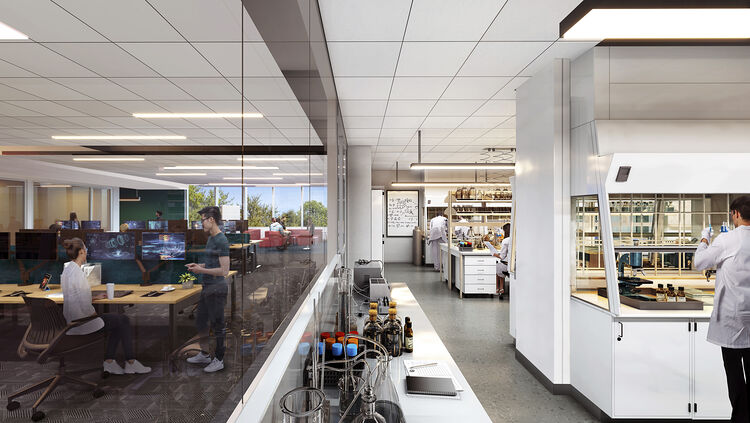
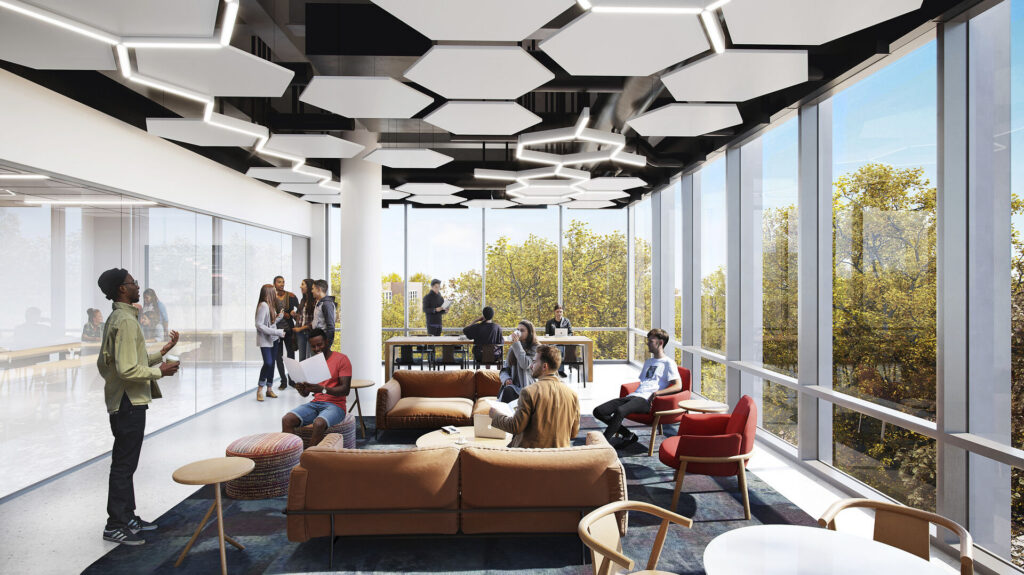
Architecture trends now accommodate this blind spot by adopting a “research neighborhood” approach to design. Research neighborhoods are clusters of laboratories, shared resources, collaboration spaces, and amenities that encourage interaction between teams and disciplines.
Research neighborhoods create an opportunity for scientists to share expertise across many disciplines.
“When individual niche research becomes stagnant, a researcher just down the hall could provide the missing perspective another needs.”
Research facilities, like North Carolina State University’s Integrative Sciences Initiative at Woodson Hall, are built with the understanding that unconventional layouts and uncommon interactions keep progress moving. Woodson Hall houses no single department, serving as a meeting ground for interdisciplinary research. Faculty members apply for temporary space assignments based on their research needs, maintaining a consistent turnover of resources and availability.
“You’ll see a long corridor with many labs along the way, or an open room with desks and rows of work benches,” says BrightTree Studios Senior Telecom and Security Designer Kyle Stille, RCDD. “The labs have shared instrumentation, so everyone can work together. It’s one collaborative space.”
The architectural structure of a research facility is the backbone, but collaborative study doesn’t begin without integrated technology and networking. High-speed network infrastructure and secure data systems supplement a facility’s shared instrumentation, and wireless connectivity enables researchers to move seamlessly between spaces and disciplines.
“My goal for the project design is for users to not notice that we’ve been there,” says Stille. “The data outlets are there where they need it, and they’re never thinking, ‘I need to plug my laptop in here and I can’t.’ We want to be in the background, and we want to provide that convenience, so that they’re able to work seamlessly and efficiently.”
Architecture and thoughtful technology design sustain the exchange of knowledge between people who may approach the same challenge from different perspectives. “You want the cross-training interaction. If one person is working on one project and another is working on something different, they can cross-pollinate and share techniques,” Stille says. “If someone sees another person struggling, they can step in and help.”
Woodson Hall’s three centralized labs are the backdrop for molecular sciences like chemistry, physics, biology, agriculture, and engineering. These shared spaces incubate collaboration, where multidisciplinary “cross-pollination” can bridge gaps in the discovery of molecules and their practical uses.
Yale University’s Life Sciences Building at 101 College Street reflects this same foundation—the 7-floor facility houses a cinema microscopy lab, electrophysiology core, and vivarium research suite, all under one roof. Each floor can accommodate more than 80 researchers at one time.
Research neighborhoods serve a present-day science as well as save a seat for whatever comes next. As new studies, priorities, and technologies evolve and emerge, a neighborhood research facility is designed with ample space to support study in fields that may not even exist yet.
Research neighborhoods are built on the idea that innovation rarely happens in isolation. By aligning technology strategy with the goals of research neighborhood planning, organizations can create environments that foster collaboration, innovation, and discovery.
Meticulous, innovative technology design enables natural collaboration in a way that lets researchers use the resource they already have in one another. The next breakthrough may not come from a new piece of equipment, or a larger laboratory. Sometimes, all it takes is a fresh set of eyes, or a new angle seen by someone just down the hall.
More Insights


